Smart Vending Machines vs. Traditional Vending Machines: Key Differences
 By
 11 minutes
 Posted on: 05 May, 2026

Vending started with coin-operated machines that worked on their own. Today, many machines connect to the cloud and report every sale.
Customers now expect to buy food and essentials at any hour, often without cash. The Federal Reserve reports that cash made up just 14% of U.S. consumer payments in 20251.
Operators want 24/7 sales, cashless checkout, and low-maintenance retail with fewer wasted trips to machines that need no service.
This article compares the smart vending machine vs. traditional vending machine, also called the smart vending machine vs. regular vending machine question, and how Trinity Axis Inc. offers the benefits of both.
Trinity Axis builds smart vending hardware and software for businesses and operators. Its TRIO line covers machines, kiosks, retrofit kits, and software.
What Are Traditional Vending Machines?
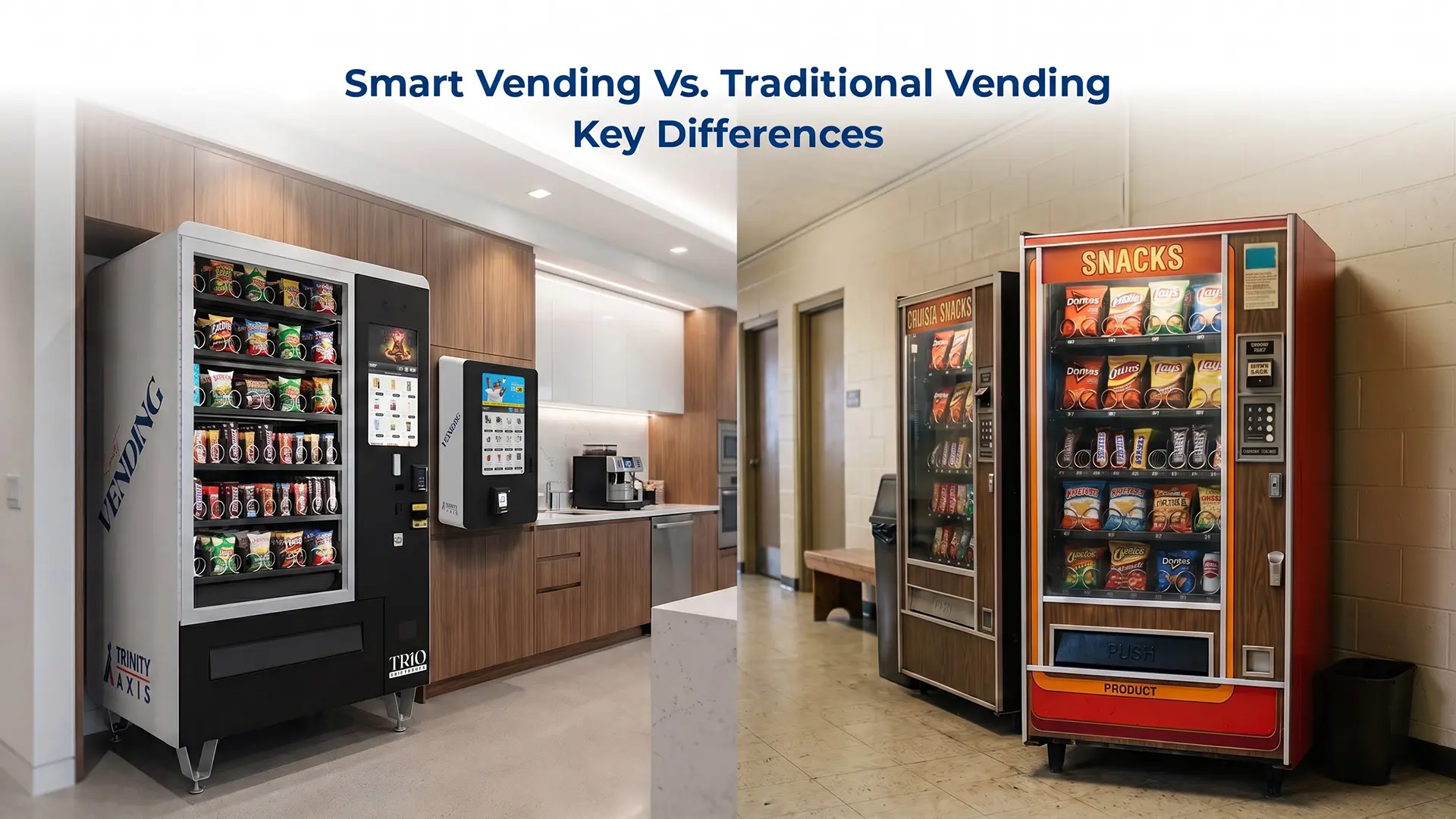
A traditional vending machine stores, sells, and dispenses products. The customer pays, picks an item, and collects it.
Many accept coins, bills, and sometimes cards. Most, however, work alone and share no live data with the operator.
To learn what is sold, the operator must visit. A route driver checks stock, refills slots, collects cash, and changes prices by hand.
This model works for one or two machines. Across many locations, manual checks cost more time, fuel, and labor.
What Are Smart Vending Machines?
A smart vending machine joins product dispensing with payments, connectivity, and software. People also call it an intelligent vending machine, a connected vending machine, or a cloud-connected vending machine.
Five features make a vending machine smart. They are cashless payments, an internet connection, remote inventory tracking, sales reporting, and central vending machine management software.
Many models add a touchscreen, digital advertising, and alerts. A touchscreen alone does not make a machine smart. The software and data link does.
A smart vending machine works as an automated retail vending machine. It sells 24/7 without staff and sends each transaction to a dashboard.
Key Differences Between Smart Vending and Traditional Vending
| Area | Traditional Vending Machine | Smart Vending Machine |
|---|---|---|
| Connectivity | Limited or standalone | Connected to software |
| Payments | Cash and/or card | Digital payment support |
| Inventory | Mostly checked on-site | Remote inventory visibility |
| Sales Data | Basic or manual | Central sales reporting |
| Pricing | Often changed at the machine | Can be managed remotely |
| Monitoring | Physical inspection | Remote information available |
| Customer Interface | Buttons or keypad | Digital or touchscreen interface |
| Advertising | Limited | Digital advertising options |
| Multi-location Management | More manual | Centralized management |
| Restocking | Based on checks and estimates | Supported by sales and stock data |
The sections below explain each difference shown in the table.
1. Technology & Connectivity
A traditional machine keeps its data inside the cabinet. Operators read it on-site.
A connected vending machine sends data over a cellular or Wi-Fi network to cloud software. Operators can remotely manage each machine and track stock levels, transactions, and alerts from a laptop or phone, along with inventory, prices, and planograms.
This matters most when machines sit in many buildings. It is especially useful across multiple locations and can support integration with asset management systems. One manager oversees the whole fleet without driving to each site.
2. Payment Options
Traditional vending does not always mean cash-only. Many older machines accept cards through an added reader separate from the machine’s software.
A cashless vending machine accepts credit cards, debit cards, contactless cards, and mobile wallets, making each purchase easier. Many digital setups also support cashless payment options. Customers no longer need exact change.
Cashless payment is now standard. NAMA’s 2020 industry census found that 80% of vending machines accepted non-cash payments, up from 69% in 20182.
A cashless vending machine for business also supports higher sales. NAMA reports that consumers tend to spend more per transaction when they do not insert cash3.
Cash still matters, though. The Federal Reserve found that 90% of U.S. consumers plan to keep using cash, so many operators offer both4.
3. Inventory Management
Inventory marks one of the biggest gaps. With a traditional machine, the driver learns what is empty only after opening the door.
A vending machine inventory management system updates stock with every sale, helping operators track inventory and product movement in real time. A vending machine with real-time inventory shows low items, fast sellers, and slow sellers before the driver leaves, and operators can act on low stock alerts before a machine runs empty.
Operators then build a picklist of exactly what each machine needs. Drivers load the right products and skip full machines.
This is how smart vending machines reduce vending route servicing. Operators replace fixed schedules with visits based on actual stock.
In the Trinity Axis lineup, TRIO VMS manages products, pricing, planograms, inventory, and machines. The TRIO Daily Plus App handles stockroom inventory, picklists, and restocking in the field.
4. Data & Analytics
A vending machine with sales analytics shows which products sell, where they sell, and when; more advanced systems use predictive analytics to forecast demand and improve the product mix. Operators compare machines and locations from one screen.
The data drives better choices. If one snack sells out every week and another barely moves, the operator swaps the slow item and updates the planogram, with better visibility into sales data helping increase sales and overall revenue potential by stocking what actually moves.
Pricing follows the same logic. Operators change prices remotely and measure the result in their sales reports.
5. Maintenance & Operations
Every vending machine still needs cleaning, restocking, and repairs. Smart technology does not remove physical service, but it removes the guesswork.
A vending machine with remote monitoring flags lost connections, low stock, and selected machine faults. Route teams arrive knowing what to fix. In practice, smarter monitoring can reduce hardware support tickets significantly.
Operators also manage machines across many locations from one account instead of tracking each one through site visits, which means better route planning, fewer trips, and smoother scaling for an existing operation.
6. Customer Experience
Traditional vending follows a simple path of choose, pay, and collect. Customers understand it, and it still works well, but it usually offers only limited product information through small labels.
Smart vending adds a clearer display. Touchscreens show product images, prices, product details, and promotions, which helps customers decide faster. They can also replace the fixed physical price tags that traditional machines require operators to update by hand.
Good design keeps the process short and adds no extra steps. That can improve customer experience and make product access more convenient.
Cost Comparison: Short-Term vs. Long-Term Value
Is a smart vending machine worth the higher upfront cost? The answer comes down to how many machines you run and how you plan to service them.
Smart vending machine cost includes the cabinet, payment hardware, touchscreen, installation, and software subscription. Prices vary by size and features, so request quotes for your exact setup.
A traditional machine with basic functions usually costs less to buy. A smart machine may cost more at first because it carries more technology.
| Cost Area | Traditional Vending | Smart Vending |
|---|---|---|
| Initial cost | Usually lower | Usually higher |
| Inventory checks | More manual | Remote visibility |
| Route planning | Based more on visits | Supported by machine data |
| Analytics | Limited | More detailed |
| Multi-location control | More manual | Centralized |
Long-term value comes from daily operations. Remote inventory, fewer wasted trips, cashless sales, and a better product mix lower running costs across a fleet.
One machine in a small office runs fine with basic features. An operator with dozens of machines gains the most from central software.
So the real question is not only which machine costs less. Ask which system fits the way you plan to run your vending business.
Use Cases: Where Smart Vending Outperforms Traditional Machines
A smart vending machine for business performs best where people need products at all hours, and staff cannot run a full store.
1. Workplaces
Employees buy snacks, drinks, meals, and essentials without leaving the site. A company can also use a single machine to give employees quick access to snacks, drinks, and basic accessories without leaving the workplace. NAMA names manufacturing sites and office buildings as top growth locations for vending operators5.
2. Educational Campus
Students buy food, drinks, supplies, and personal care items late at night, after campus stores close, so machines in high-traffic locations across campus can keep serving users when staffed retail is unavailable.
3. Hotels
Guests buy food, beverages, and travel essentials at any hour without a staffed shop.
4. Gyms
Members buy drinks, nutrition products, and accessories right before or after workouts from machines placed near lockers, exits, or the front desk.
5. Residential Communities
Residents buy everyday items inside their building, which saves a late trip to the store.
6. Micro Markets and Specialty Retail
Self-checkout kiosks run micro markets, which grew from 9% to 20% of convenience services revenue between 2019 and 2023, according to NAMA6. Smart vending and kiosks also help retailers expand unattended retail with more complete control over products and checkout.
Why Businesses Are Switching to Smart Vending Machines
Traditional vending focuses on selling and dispensing products. Smart vending adds payments, inventory data, software, reporting, remote control, and stronger security.
The smart vending machine benefits are practical. Operators see what sells, what needs restocking, which machine needs attention, and which location performs best. Smart systems can also handle safety supplies, reduce manual data entry, and give operators a clearer view of how to scale across multiple locations.
The wider market supports this shift. NAMA valued U.S. convenience services at $26.6 billion in 2023 and projects about 9% average annual growth through 20287. New capabilities increasingly rely on modern technologies, including artificial intelligence for automation and optimization.
NAMA also lists technology innovation among the main forces behind that growth8.
Can You Upgrade a Traditional Vending Machine?
You do not always need a new machine. Many operators upgrade traditional vending machine fleets with cashless payments, connectivity, telemetry, and new controls instead of replacing them.
Before you modernize existing vending machine hardware, check the model, controller, communication ports, condition, and features you need.
Trinity Axis offers the TRIO Revision Kit for compatible legacy vending machines. It offers a middle path between keeping an old machine unchanged and buying new.
Why Choose Trinity Axis for Smart Vending Solutions
When you compare providers, look for hardware that fits your sites, reliable cashless payments, strong management software, an upgrade path, and integration with existing systems.
Trinity Axis covers each of these with its TRIO product line, from small spaces to full micro markets.
TRIO Compact brings smart vending to small spaces such as gyms and wellness centers.
TRIO Diamond, formerly TRIO Plus, offers larger capacity with flexible product configurations.
TRIO Kiosk supports self-checkout in micro markets and other unattended retail spaces.
The TRIO Revision Kit converts compatible traditional machines into smart vending machines.
TRIO VMS gives central control of machines, products, pricing, planograms, inventory, and reports. It also helps operators track machines across multiple locations and supports a more complete smart vending operation. Operators also schedule vending machine advertising directly from TRIO VMS.
The TRIO Daily Plus App supports field teams with stockroom inventory, picklists, and restocking. Together, these products let operators run every machine from one connected system and manage an existing operation more efficiently as they grow.
Conclusion
The smart vending machine vs. traditional vending machine choice comes down to control and information.
Traditional machines still suit simple needs at a single site.
Smart vending adds cashless payments, remote inventory, sales analytics, digital screens, and central management. These tools make multi-location vending easier to run.
Operators with older machines upgrade compatible units rather than replace them, which protects equipment they already own.
For new installations and legacy upgrades, Trinity Axis offers TRIO smart vending solutions for businesses and vending operators.
References
- Federal Reserve report – Cash made up just 14% of U.S. consumer payments in 2025
- NAMA’s 2020 industry census – Cashless Payments
- NAMA reports – consumers tend to spend more per transaction when they do not insert cash
- Federal Reserve report – 90% of U.S. consumers plan to keep using cash
- Manufacturing and office buildings are top growth locations for vending operators.
- NAMA report – Micro markets grew from 9% to 20% of convenience services revenue between 2019 and 2023
- NAMA report – U.S. convenience services value $26.6 billion in 2023
- NAMA report – Technology innovation for convenience industry growth to pre-pandemic level